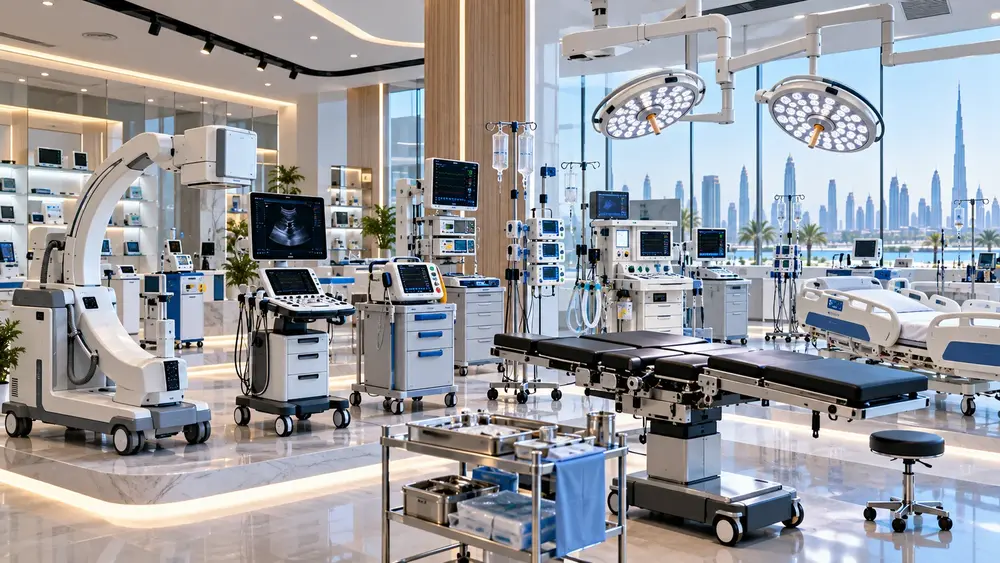
Procuring equipment for a single clinic is a manageable task. Procuring equipment for a multi-department hospital, with dozens of specialties and hundreds of individual devices, is a different challenge entirely. For hospital administrators and procurement teams across the UAE, the relationship withHospital Equipment Suppliers has to work at scale, across departments, budgets, and long procurement cycles that stretch years into the future. Getting this relationship right affects everything from operating theatre uptime to how quickly a new department can open its doors.
Why Hospital-Scale Procurement Is Different
A single clinic might buy from two or three suppliers and manage the relationship informally. A hospital cannot operate that way. With radiology, surgery, ICU, laboratory, dental, and outpatient departments all needing different categories of equipment, hospitals need hospital equipment suppliers who can manage large, multi-department contracts without losing track of specifications, delivery timelines, or after-sales obligations.
This scale also raises the stakes of a poor supplier choice. A missed delivery date for a single clinic’s ultrasound machine is an inconvenience. A missed delivery date for a new hospital wing’s entire imaging suite can delay an opening by months and affect dozens of planned staff hires.
Many UAE hospitals are moving away from sourcing equipment from a long list of small, category-specific vendors and instead consolidating purchases with a smaller number of broad-range hospital equipment suppliers. This approach simplifies contract management, creates clearer accountability when something goes wrong, and often improves pricing through larger combined orders.
Consolidation is not right for every category. Highly specialized equipment may still need a niche vendor. But for the bulk of general clinical, monitoring, and furniture needs, working with fewer, larger hospital equipment suppliers tends to reduce administrative overhead significantly.
Evaluating Suppliers for Multi-Department Contracts
When negotiating a hospital-wide supply agreement, procurement teams should look beyond price per unit and examine how a supplier handles complexity.
Can they manage staggered delivery schedules across multiple departments without delays cascading between them?
Do they provide a single account manager for the hospital, or will each department deal with a different contact?
What happens if a specific model is discontinued mid-contract — do they offer an equivalent replacement path?
Can they support a phased rollout, such as opening one wing before the rest of a new building is ready?
Compliance Across Every Department
Every device supplied to a UAE hospital, from a dental chair to a CT scanner, must meet the relevant DHA, DOH, or MOHAP requirements for its category. Reliable hospital equipment suppliers maintain a compliance library covering every product they sell, so procurement teams are not left chasing certificates department by department during an accreditation review.
After-Sales Support at Hospital Scale
A hospital’s after-sales needs are far bigger than a clinic’s. Multiple biomedical engineers, a large spare parts inventory, and structured preventive maintenance schedules across hundreds of devices are the baseline expectation, not a bonus feature. Hospital equipment suppliers who cannot demonstrate this level of support infrastructure are rarely a good fit for a large facility, no matter how competitive their initial pricing looks.
Planning for Future Expansion
UAE hospitals rarely stay the same size for long. New departments open, existing ones expand, and equipment needs to change to match. The strongest hospital equipment suppliers think beyond the current contract and help facilities plan equipment roadmaps for planned expansions, rather than treating every new department as a fresh, disconnected procurement exercise.
Negotiating Contract Terms That Protect the Hospital
Hospital-scale equipment contracts run for years, not months, so the terms negotiated at the outset matter enormously. Procurement teams should push for clear service-level agreements covering response times, defined escalation paths for unresolved issues, and price protection clauses that guard against sudden cost increases mid-contract. It is also worth negotiating fixed pricing for common spare parts and consumables, since these costs can otherwise creep upward once a hospital is locked into a single supplier relationship.
Penalty clauses for missed delivery or response-time commitments give hospitals real leverage if a supplier’s performance slips over the life of the contract, rather than leaving the hospital with no recourse beyond a difficult conversation.
Paramount UAE: Your Partner in Hospital Equipment Suppliers
Paramount UAE works with hospitals across the UAE and wider GCC on large, multi-department equipment contracts, spanning radiology, surgical, patient monitoring, dental, laboratory, and veterinary categories. Their team provides a single account structure for hospital clients, coordinated delivery scheduling across departments, and a compliance library covering every product they supply, helping procurement teams manage complex contracts with far less administrative strain.
Conclusion
Choosing between Hospital Equipment Suppliers at hospital scale requires a different evaluation than a single clinic purchase. Hospitals need partners who can manage complexity across departments, maintain compliance documentation for hundreds of devices, and provide after-sales support strong enough to keep every specialty running. UAE hospitals that consolidate around proven, well-resourced suppliers like Paramount UAE put themselves in a far stronger position than those managing dozens of fragmented vendor relationships.