Medical imaging has long been a cornerstone of modern healthcare, helping doctors diagnose, monitor, and treat patients with greater accuracy. Among all imaging methods, X-rays remain one of the most commonly used technologies. However, the field has advanced far beyond traditional film-based imaging. With rapid technological progress, healthcare providers now rely on digital, portable, and AI-powered systems that deliver faster, more precise, and safer results.
In the UAE and around the world, hospitals and diagnostic centers are adopting next-generation X-ray technologies to enhance patient care, streamline workflows, and improve diagnostic confidence. This article explores the emerging trends shaping the future of X-ray imaging and what healthcare providers can expect in the coming years.
The transition from conventional to digital photography
One of the most important developments in medical imaging was the transition from analog film to digital radiography (DR). Digital X-ray enables images to appear immediately without it being developed. This not only accelerates the diagnosis but also reduces costs.
New digital X-ray systems deliver better image quality at a lower dose. Radiologists rely on the ability to manipulate images, but that often involves adjusting brightness, contrast, or magnification. What’s more, digital storage and sharing options help health care teams work together better – even when they are in the same hospital or at separate sites.
For health care providers, digital X-ray systems are critical for enabling fast, accurate diagnoses that improve patient throughput and satisfaction.
Artificial Intelligence: A New Dimension in Diagnosis
The field of X-ray interpretation is being revolutionized by the advent of Artificial Intelligence (AI). AI algorithms can examine images with astonishing precision, helping radiologists detect the unusual lung patterns of fractures, lung infections, or tumors in seconds.
Leading applications of AI in X-ray imaging are as follows:
- Automated Detection: The study found that A.I. tools could provide early warnings of potential problems on chest or skeletal X-rays — such as early signs of pneumonia in the former and bone fractures in the latter — thereby lessening the risk of human error.
- Workflow Optimisation: AI systems can triage critical cases in an imaging queue, enabling doctors to see critical patients more quickly.
- Greater Accuracy: Machine learning gets smarter with each attempt and learns from larger datasets, resulting in higher diagnostic accuracy.
Healthcare providers in the UAE are increasingly deploying AI-powered imaging solutions to improve diagnostic quality and operational efficiency. As AI advances, it will be the norm in radiology departments worldwide.
Portability and Point-of-Care Imaging
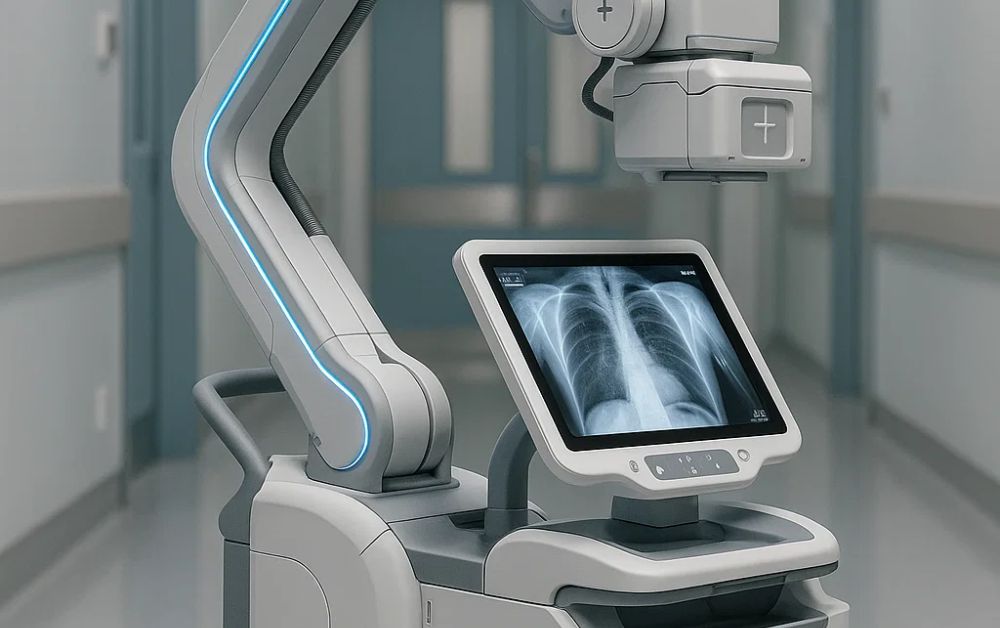
New portable X-ray units are changing how and where imaging can be performed. Traditionally, X-rays were limited to hospital radiology rooms. Today, there are small and portable systems in which it is possible to conduct imaging at the bedside of a patient, in an operating room, or even in an out-of-the-way location.
Pros of Portable X-Ray: There are several benefits of a portable X-ray system:
Rapid Diagnosis: In emergency and ICU settings, when moving patients is not feasible.
Greater Access: Allows for imaging in rural or mobile care facilities.
Promotes Patient Safety: Minimizes the risk of patient transport, especially for severely injured patients.
As the need for healthcare continues to rise in places such as the UAE, portable X-ray machines are becoming an asset not only in hospital settings but also for clinics and even home healthcare service providers.
Low-Dose and Safer Imaging Technologies
Patient safety has always been a significant factor in radiology. Current developments aim to reduce radiation exposure while maintaining high image quality.
Manufacturers of advanced detectors and image-processing software are developing equipment that uses far less radiation to create diagnostic-quality images. Automated features like automatic exposure control and adaptive filtration provide maximum results with minimal risk from every scan.
This is especially useful in the pediatric and geriatric populations, who are more sensitive to radiation. As technology evolves, the trade-off between diagnostic clarity and patient safety will only improve.
Cloud and PACS Integration
The network of X-ray machines connected to Picture Archiving and Communication Systems (PACS) or the cloud is miraculously changing the healthcare pathways. These tools facilitate the secure storing, retrieval, and sharing of medical images within departments or between hospitals.
Key benefits include:
- Immediate Access: Images are available for radiologists outside the diagnostic center, reducing response times.
- Security: Patient data is protected by encrypted cloud systems.
- Enhanced Collaboration: Experts can readily communicate about complicated cases across various regions.
This interconnected ecosystem supports efficient diagnosis, especially in multi-branch healthcare organizations or during teleconsultations. As digital infrastructure expands across the UAE, more healthcare providers are adopting cloud-based X-ray solutions in UAE to streamline imaging and improve collaboration.
3D and Tomosynthesis Imaging on the Rise
Another interesting advancement in X-ray technology is 3D tomosynthesis, a technique that produces multiple images of an area from many angles, providing a more three-dimensional (layered) view. This is especially useful in breast imaging and orthopedics, where subtle details may not be visible on standard 2D images.
3D imaging for easier understanding of complex anatomical structures, minimizing interference from overlapping tissue, and improving diagnostic confidence. As prices drop, additional healthcare facilities are projected to adopt 3D tomo systems as part of their radiology modus operandi.
In Conclusion
The future of X-ray imaging is dynamic, data-driven, and deeply connected to digital innovation. From AI-based diagnostics to low-dose imaging and portable systems, these advancements are enabling healthcare providers to deliver faster, safer, & more precise care. As hospitals and clinics continue to embrace these trends, patients can look forward to more efficient and comfortable imaging experiences.
For those looking to invest in the latest X-ray solutions in the UAE, Paramount Medical Equipment Trading LLC is a trusted source for advanced imaging systems and expert support tailored to meet the evolving needs of modern healthcare.